Consolidating Procurement Volume for Critical Spare Parts
A centralized procurement pilot for oxygen compressor service kits achieved 19–28% cost savings per spare part and reduced delivery times by up to 6 months over a year-long pilot across LMICs.
In many low- and middle-income countries, oxygen systems do not fail because the core equipment is missing. They fail because routine maintenance parts are difficult to access when needed. In support of a global health implementation effort, we examined one such challenge: improving access to service kits for oxygen compressors costing between a few thousand and up to low five digit dollars, a small but essential input for keeping PSA and VSA plants running and preserving cylinder-filling capacity. The central lesson was straightforward — when demand for critical spare parts is fragmented across many facilities and countries, consolidating procurement volume can improve access, reduce costs, reduce lead time and strengthen supplier responsiveness.
The problem
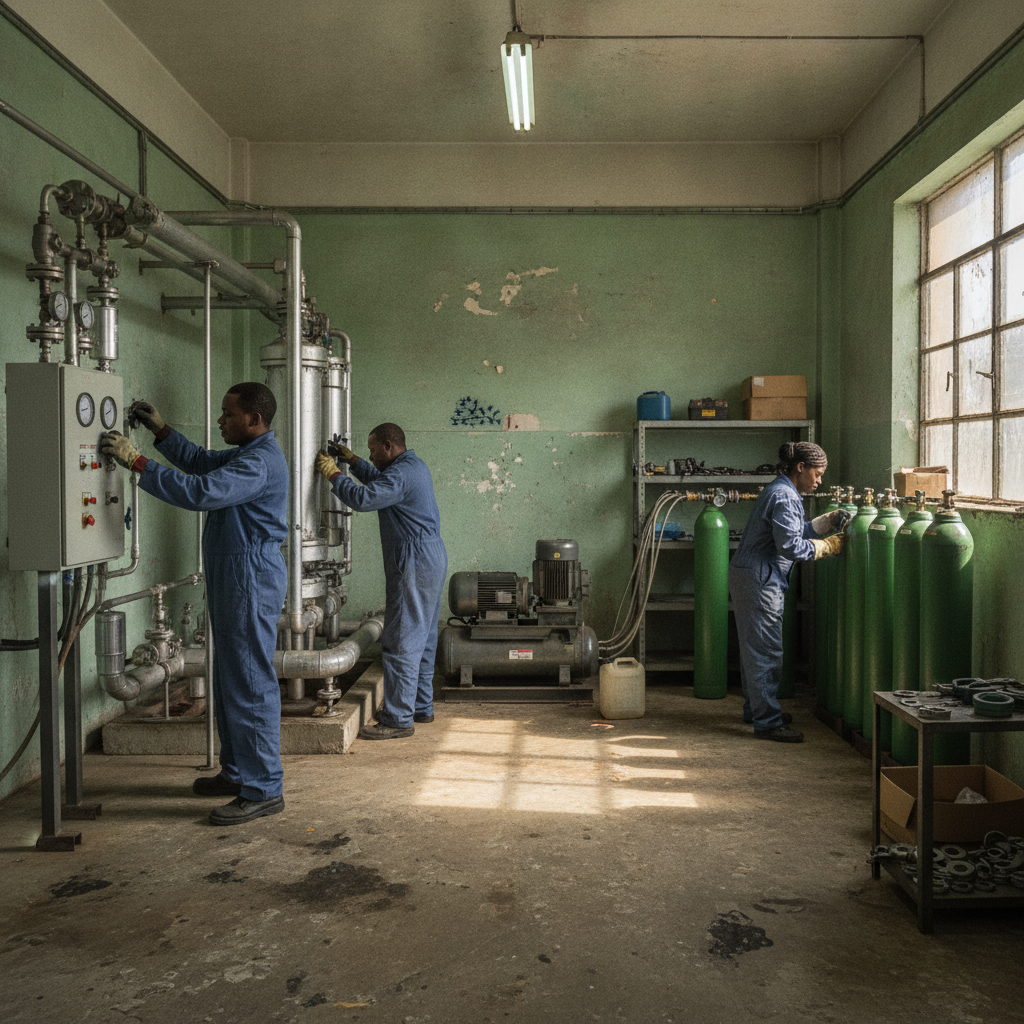
Oxygen compressor service kits sit at a critical point in the supply chain. Compressors must be serviced regularly, typically every 2,000 to 8,000 hours, and many plants across low- and middle-income countries depend on them to fill cylinders. That cylinder-filling function is operationally important: it provides backup supply, supports neighbouring facilities, and allows systems to respond when oxygen demand fluctuates.
Yet the spare parts needed to sustain this capacity are often procured through sporadic, one-off requests from facilities with limited technical capacity, constrained budgets, and little visibility into where and how to source the right parts. The result is a supply chain defined by friction: long lead times, repeated follow-up, weak price leverage, and preventable service interruptions.
The approach
To address this, a centralized procurement mechanism was piloted in partnership with a major manufacturer of oxygen compressors. Rather than leaving each facility to navigate supplier identification, technical specifications, pricing, order placement, logistics, and importation alone, the mechanism aggregated demand, placed orders in batches, pooled inventory at an international logistics hub, and acted as an intermediary between buyers and the manufacturer. In practice, this reduced fragmentation on both sides of the market. Facilities faced a simpler ordering process, while the manufacturer handled fewer small, administratively burdensome transactions and benefited from more predictable demand.
The impact
The clearest impact was financial. Over a year long pilot period, the mechanism converted demand from many facilities into 145 fulfilled kit orders across countries spanning Latin America, sub-Saharan Africa, and the Middle East. By consolidating purchases into batches and streamlining logistics, it achieved cost savings of 19% to 28% across kit types.
For resource-constrained health systems, those savings are significant. They can determine whether a facility restores oxygen production quickly, delays maintenance, or continues operating below capacity.
One example illustrates the stakes. When a major public hospital in Madagascar experienced oxygen compressor failures, it lost 20 cylinders of medical oxygen per day — equivalent to roughly $39,600 over two months. Local sourcing options for spares existed, but quoted prices were approximately double what the centralized mechanism could offer. Accessing service kits through the pooled approach enabled the hospital to restore oxygen production to full capacity. This is the strategic value of procurement volume consolidation: it does not simply lower unit prices; it helps protect continuity and creates resilience of clinically critical systems.
The pilot also improved the procurement experience itself. Facilities reported that the mechanism reduced the burden of identifying the correct parts, using technical terminology, and coordinating with multiple actors across the supply chain. A simpler form and a single entry point removed friction that would otherwise slow or derail purchasing.
What the pilot revealed
Time savings were real, though more variable. In some cases, the mechanism reduced delivery timelines by as much as six months and helped buffer production delays through more proactive ordering. But the work also showed that the longest delays often occurred beyond the supplier interface itself — particularly around recipient approvals, import waivers, and customs clearance. In other words, volume consolidation can improve upstream efficiency, but downstream administrative barriers still shape how quickly spare parts reach facilities.
Recommendations
Volume concentration is not a universal solution. It works only where demand can be aggregated across enough buyers to create meaningful scale, and not all products lend themselves to this approach. The suitability of the product, the fragmentation of demand, and the willingness of suppliers to engage on different terms are preconditions that must be assessed case by case.
Where consolidation is feasible, the broader lesson is that consolidated procurement works best not as a standalone buying tactic, but as a supply chain coordination model. Aggregating demand lowers transaction costs, improves pricing, and gives suppliers enough confidence to plan ahead. But to fully translate those gains into timely access, the model must be paired with financing solutions, stronger demand visibility, and delivery arrangements that reduce in-country bottlenecks.
This also involves a logistics trade-off. To avoid country-specific importation delays, one could position centralized stock within a country so the import hurdle is cleared in advance. That only works, however, if national demand is large enough to justify holding inventory locally — something that was not the case in this particular intervention, where demand was too dispersed across borders to make national stocking viable.
For senior decision-makers, the implication is clear. Procurement volume consolidation is not simply about buying more at once. It is about creating a more reliable market interface for critical health commodities that are too often procured in a fragmented and reactive way.
Three priorities stand out for scaling this type of model:
- First, address financial accessibility through mechanisms such as revolving funds, targeted grant support, or better structured payment terms.
- Second, build sustained order volume by increasing awareness and, where appropriate, broadening the range of spare parts included.
- Third, shorten delivery timelines by redesigning inventory and import processes, especially in areas where customs and waiver procedures create avoidable delays.
The next question is not whether the model can work in the right conditions, but how to identify where those conditions exist and how to scale while preserving the features that made it effective.
For more information, please reach out to info@leap-ahead.io.